We stayed overnight on the boat at Dubrovnik and disembarked for the final time this morning. Thomas went around and said good bye to his favourite deck hand – who coincidentally had been working in Baku last year during the Azerbaijan Grand Prix and had showed him some videos from the event. We left the boat and took a bus to the cable car which took us high above Old Town to the summit of Mount Srd. The cable car was established in 1969, however, during the 1991 Siege of Dubrovnik (the Homeland War), the upper station and the nearby Imperial Fortress became crucial defensive holdouts for Croatian forces. The entire cable car system was completely targeted and destroyed by Yugoslavian artillery shelling. It stood broken for nearly two decades before being fully rebuilt and reopened as a modern, high-tech attraction in 2010.

We then made our way down and met our tour guide for a walking tour of Old Town. Dubrovnik, also known as the “Pearl of the Adriatic,” it is a UNESCO World Heritage Site globally famous for its exceptionally well-preserved 16th-century stone fortifications and limestone-paved pedestrian main street called Stradun. Throughout its 1,300-year history, Dubrovnik stood out as a sophisticated, independent-minded maritime republic that prioritised brilliant diplomacy and international commerce over military conquest.
Following a period of Venetian rule, the city broke free in 1358 and operated for nearly five centuries as the Republic of Ragusa, an autonomous merchant city-state – very similar to Singapore in the 21st century. Surrounded by the expanding Ottoman Empire and aggressive European powers, Ragusa protected itself through shrewd diplomacy, paying tributes to the Ottomans to secure exclusive trading monopolies between the East and the West. During its peak in the 15th and 16th centuries, the tiny republic operated the third-largest merchant navy in the Mediterranean.
The guide took us through the streets of old town which was the island city of Dubrovnik which was totally encased within a fort. Ironically even 500 years ago, they had a distinct quarantine facility for “visitors” outside the fort and people were kept isolated for 40 days before they were allowed onto the island.
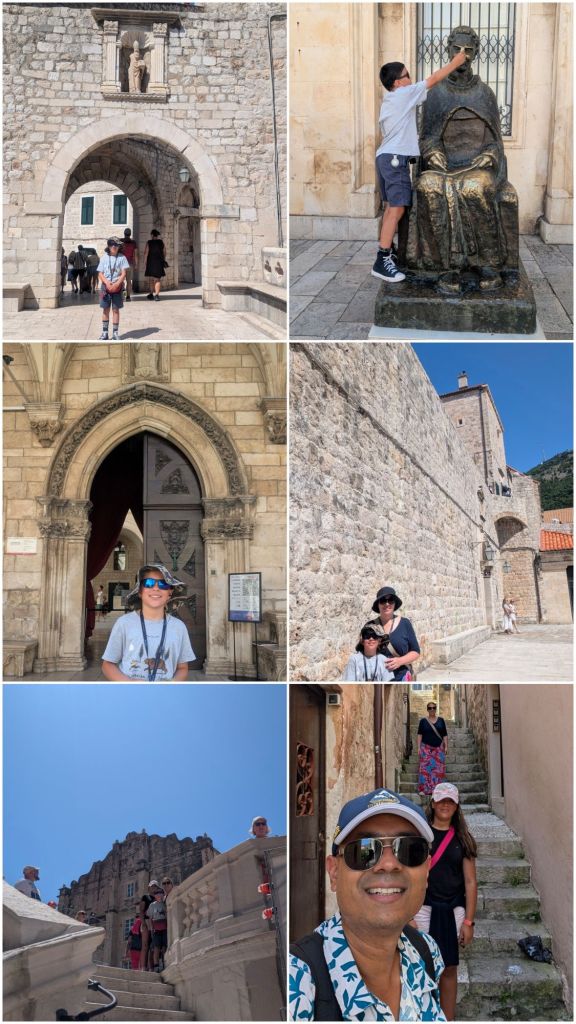
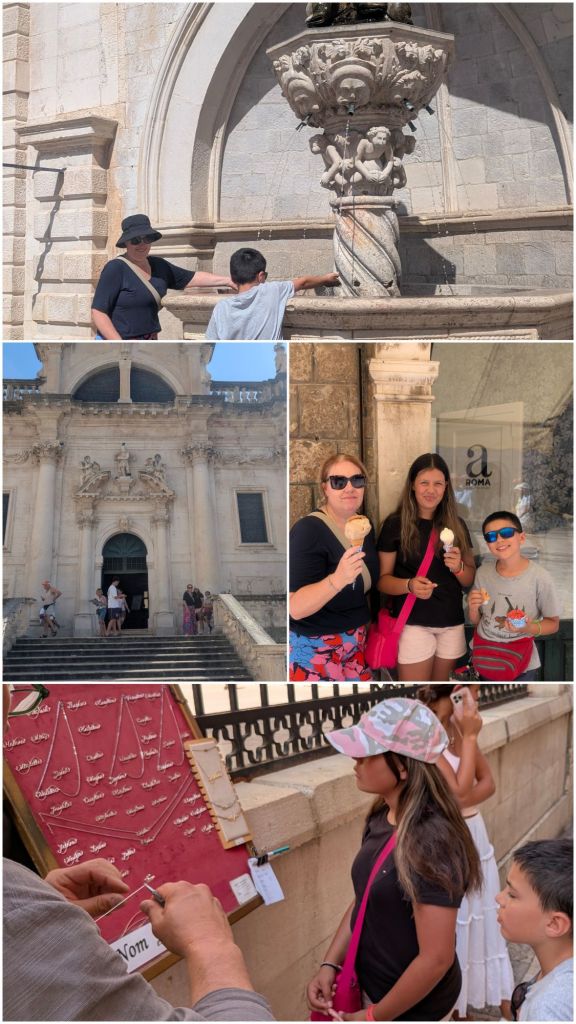
After the tour we checked into our hotel and decided to walk around by ourselves. It was incredibly hot and humid and being in a entirely rock/stone city with no trees made it seem even worse. However, everytime we walked through the old laneways it was a lot cooler than being in the open. We found some old fountains where the water was cool and fresh and also drinkable. Emily found a street vendor who made necklaces of your name with a single string of silver wire and got one done for herself. We had an ice cream stop for afternoon tea which was well appreciated by all.
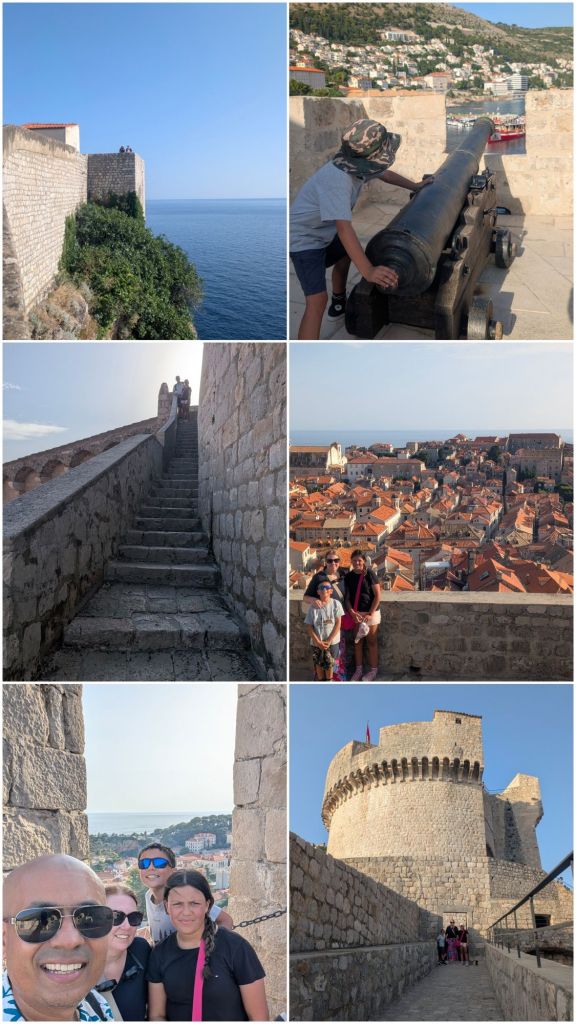
One of the highlights of the old Town is walking along the top of the stone wall that protects the city. This legendary, continuous double line of fortifications stretches almost 2 kms and required over 6M rocks to build. Reaching heights of 25 meters, the walls are fortified by defensive strongholds like Minceta Tower and the freestanding Fort Lovrijenac. It is the 2nd longest protective wall in the world – behind only the Great Wall of China. We waited till later in the afternoon when it was slightly cooler before going on this walk and spent almost 2 hours on it. There were some good vantage points however its really hard to get a photo that shows the scale and size of the fortress.
After the walk we stopped by a famous little balancing stone called the Dubrovnik Maskeron (also known as the Owl Head). It is a tiny, gargoyle-like stone carving shaped like an owl’s head that protrudes just 15 centimeters out from a smooth stone wall. There is an old local urban legend about a heartbroken young man who could not find love. He vowed that if he could successfully balance on the stone, his luck would change. He succeeded, found love shortly after, and birthed a centuries-old tradition. Thomas had a go and found success by removing his shoes and socks.
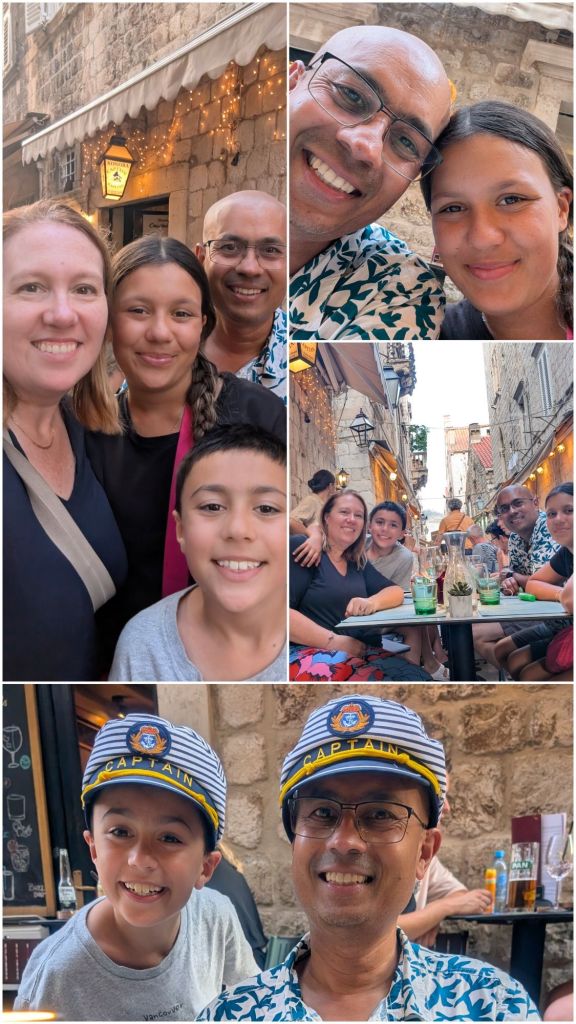
For dinner we took one of the side streets and stopped at a local restaurant. Dubrovnik is an incredibly “touristy” town and, while there are locals who live here, it is all set up for the tourist trade. We were at a local seafood restaurant and Tom and I got matching Captain hats to celebrate.